
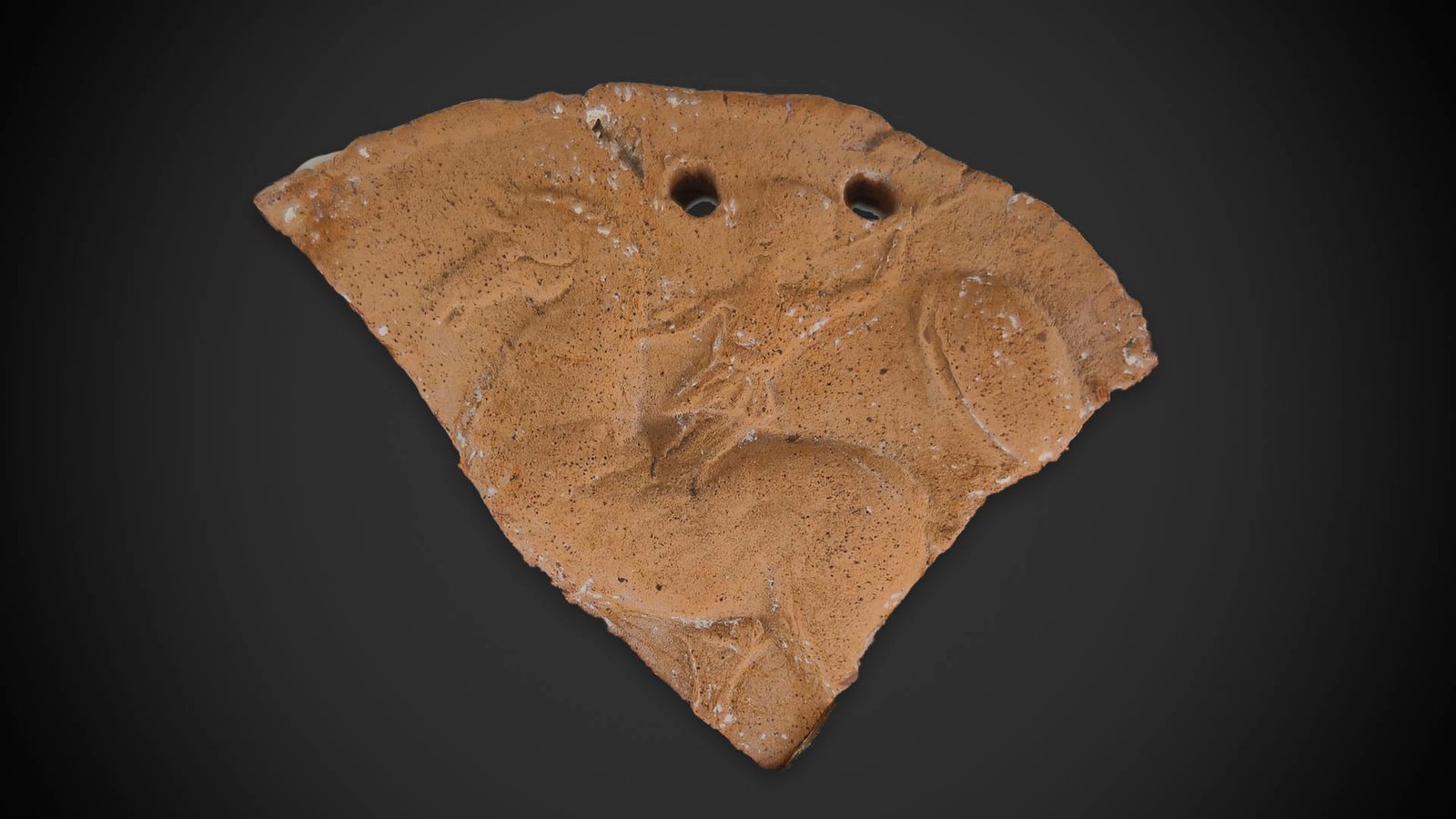
Terracotta disc with bas-relief of a horseman
Description: Fragmented disc, of which approximately two-thirds has been lost. Its reconstructed dimensions would be 10.5 cm in diameter. The piece is decorated with a bas-relief depicting a horseman riding a horse and raising a spear. The figure is wearing a short tunic fastened with a wide belt and a Montefortino-type helmet covering his head. An oval shield appears in the upper right-hand corner. It is assumed that the lost lower part of the piece featured a mythological sea creature or a dog.
Place of origin: Peñón de Salobreña.
Material and manufacture: Moulded with fired clay.
Function: This would be an oscillum, a type of piece featuring bas-reliefs on disc-shaped pieces (tondi). They were designed to be hung by a ribbon, which was passed through a hole in the piece, in the vestibule, peristyle or garden of Roman houses, so that they would spin in the wind, serving a dual purpose: religious and decorative. However, this piece may not be an oscillum, as it is decorated on only one side and has two holes (and possibly others in the missing areas), making it unsuitable for the piece to rotate. This piece may have been designed instead to be attached to an architectural or furniture surface.
Culture and chronology: Late Hellenistic-Roman. 3rd–1st centuries BCE.
Historical-archaeological context: The horseman depicted in this piece corresponds to the classic type of threatening hero or god, so widely accepted in the Iberian world that he is often associated with sea gods such as Poseidon or Melkart.