
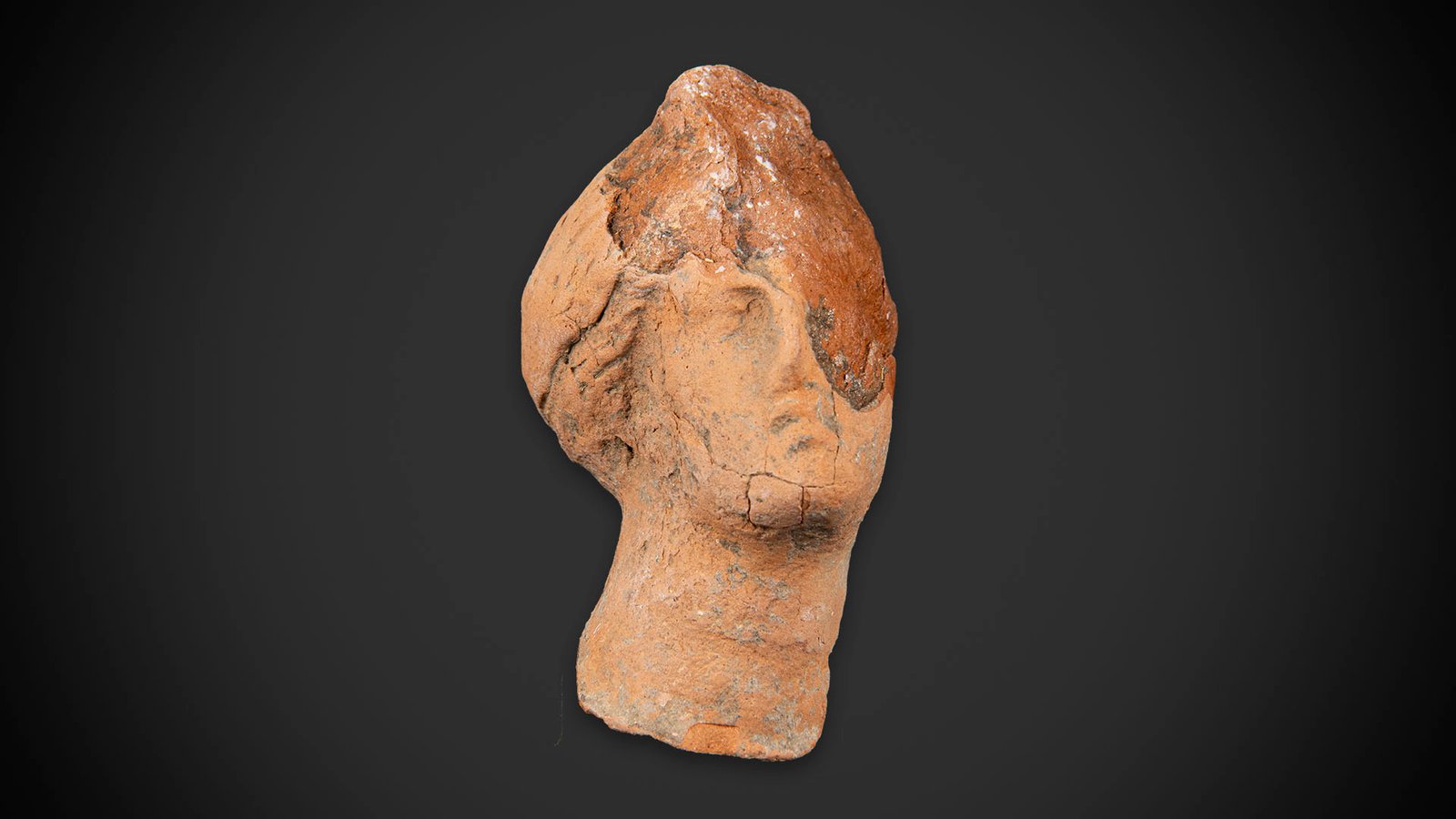
Terracotta heads and censer
Manufacture: modelled fired clay.
Place of origin: Peñón de Salobreña.
Function: probably religious.
Culture and chronology: Roman-Hellenistic (late 3rd century–mid 1st century BCE)
(1): Representation of a small head of a deity measuring 7.3 × 5.6 cm. The face is rounded, in the Hellenistic style, characterised by a small mouth, rounded chin, straight nose and eyes suggested by the relief of the eyelids. The hair is gathered at the forehead and pulled back into a kind of knot. This face is entirely classical, reminiscent of some representations of Aphrodite, but could also be related to certain images of Apollo.
(2): The head is 4.2 cm high and has clearly Hellenistic facial features. The hair is styled in a kind of bun with a series of grooves resembling a hairnet. The closest classical models to this piece are usually associated with the maternal goddesses Demeter or Ceres and their priestesses.
(3): Incense burner (a vessel in which aromatic substances are burned) measuring 6.4 cm x 5.1 cm. In this case, Punic features predominate over Hellenistic ones. This model was widely disseminated by the Carthaginians throughout the Mediterranean, constituting common pieces in the Punic and Iberian worlds. As for the deity represented, it may be the Greek goddess Demeter or the Punic goddess Tanit, a deity who is likely to be represented in this piece, influenced by Carthaginian culture and religion.