
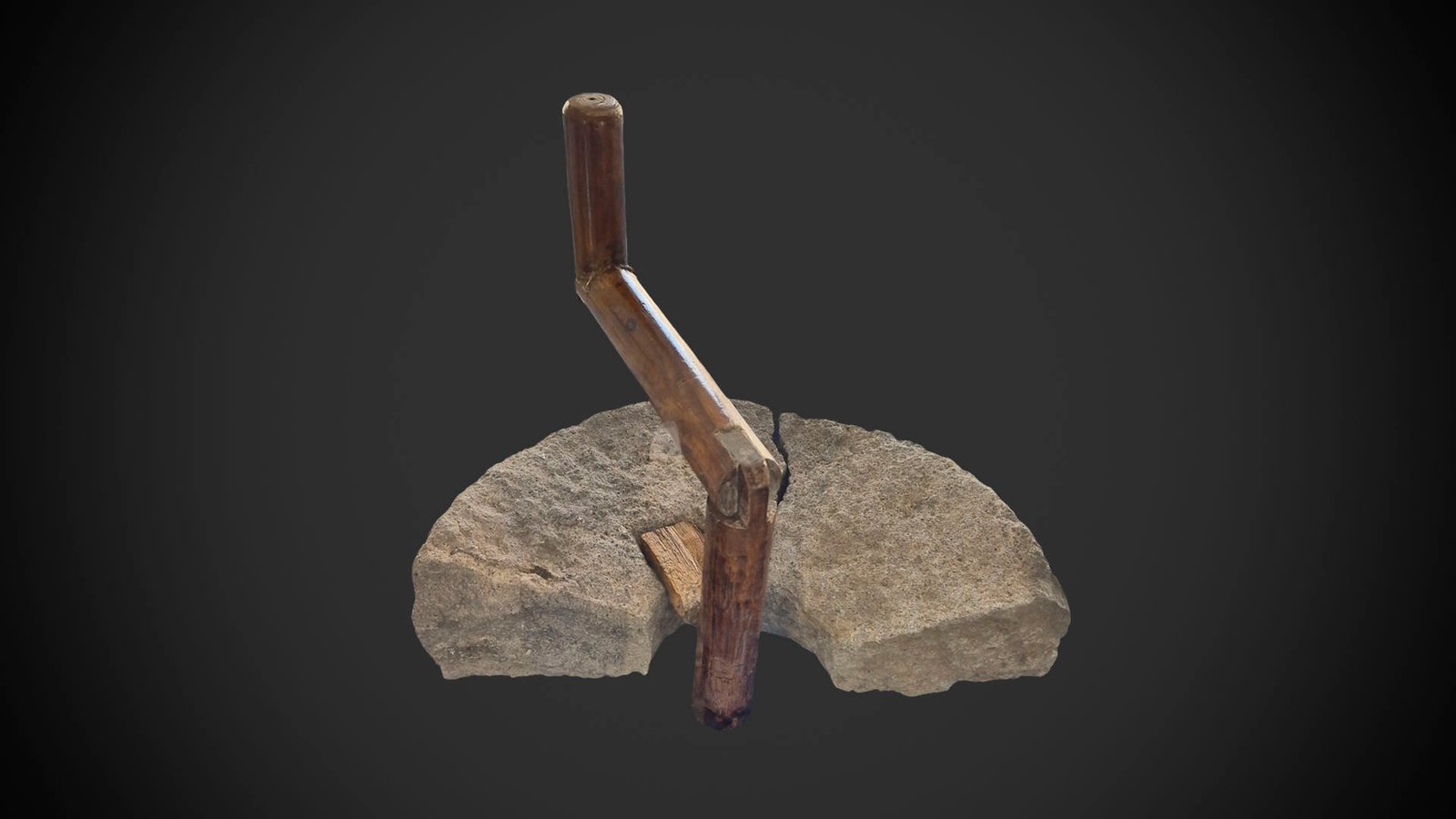
Roman mill
Description: fragment of the upper part of a manual rotary mill (mola). 44 cm in diameter, 12 cm thick on the outside and 7 cm thick on the inside. There is a rectangular recess for inserting a wooden crank to facilitate turning. They consisted of an upper part (catilus) that rotated on top of a fixed lower part (meta). The raw material to be ground was placed between the two parts.
Material and manufacture: probably sandstone.
Function: these mills were mainly used to grind wheat. However, although we have no evidence, based on the context of the find, we suggest that they were used to obtain flour and fish oils.
Place of origin: Peñón de Salobreña.
Culture and chronology: the origin of this specific type of mill can be found in the pre-Roman Iberian and Punic world from the 5th century BCE. Its use and morphology remained similar until late antiquity. Therefore, it is not easy to attribute a more specific chronology to the example we present. However, this mill could be placed in a late chronology within the Roman world (5th–6th centuries).
Historical-archaeological context: A series of Roman tools related to rod and net fishing, such as hooks, needles and shuttles, have been preserved from the Rock, along with other tools that indicate the existence of fishing activities, as well as elements of a Roman scale probably related to weighing fish. In this context, this mill could indicate the existence of a secondary industrial activity.